

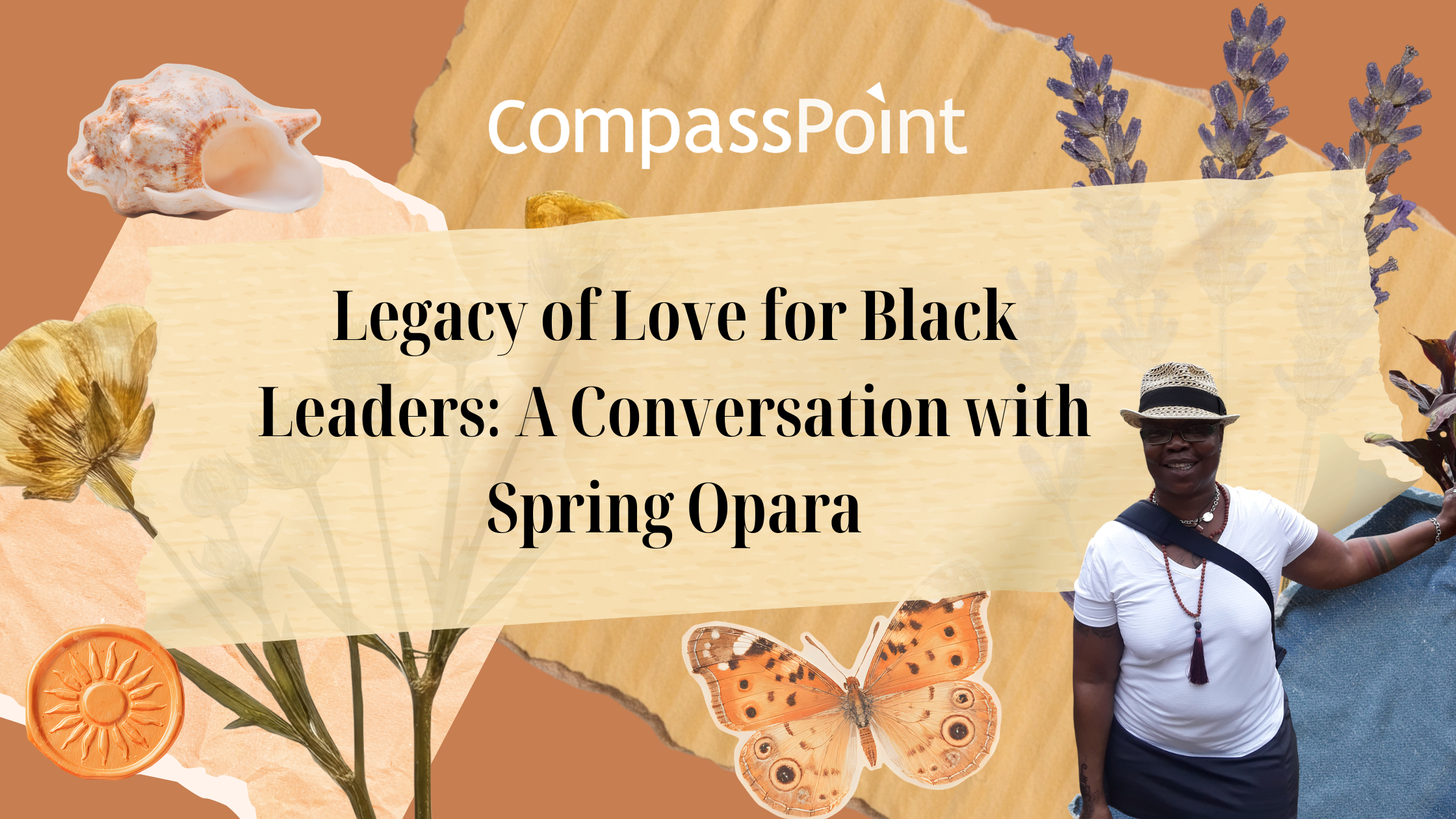
by Kyla Hartsfield and spring opara
During her twelve years at CompassPoint, spring opara experimented with systems and culture to shape how we support leaders, especially Black leaders, on the journey towards liberating themselves and their communities. She pushed us to take risks that made us uncomfortable, and resist replicating old systems that were working against our liberatory values. Her leadership centered practice over performance and people over process. spring left behind more than programs and committees. She is a living example of what it means to refuse command-and-control leadership and instead lead by example. Never shying away from rolling up her sleeves and experimenting, questioning systems, and developing spaces where Black folks could exhale without explanation.
In this conversation with Kyla Hartsfield, spring reflects on her leadership journey. From testing the system in the military to helping CompassPoint become a laboratory for a decolonized, Pro-Black leadership practice. She names the courage it takes to do something that doesn’t yet exist, and invites us to honor intuition and lead in ways that seven generations from now will thank us for. We share this conversation with deep gratitude for spring’s contributions and with a hope that it sparks reflection in you.
What does leadership look like in this season?
What are you unintentionally replicating?
Where might discomfort be inviting you to build something new?
Take a listen. Sit with it. Let it move you where it needs to.
[Intro and outro music: “Tight Soul" by Ketsa via Free Music Archive. Licensed under a CC0 1.0 Universal License.]
Enjoyed this episode and want to join our Black leadership learning series?
Transcript
(intro music)
Introductions and Leadership Journey
spring: Good morning, Kyla. How are you?
Kyla: I am doing well, spring. How are you?
spring: Doing well as well.
Kyla: That sounds good. I would love if you could introduce yourself a little bit.
spring: Okay, so my name is spring opara. I am a former CompassPoint project director. And I believe, not even I believe, I know that I'm here to talk to Kyla about the things that I did while I was at CompassPoint, AKA what is my legacy that I left behind.
Kyla: Amazing. Thank you so much. Hi everybody, my name is Kyla. I use she, her pronouns. I'm a part-time consultant with CompassPoint. And I am very excited to talk to spring about the legacy left behind at CompassPoint. And I hope y'all all enjoy this conversation. And my first question for you, Spring, is for you to tell us a little bit about what did leadership look like to you as a kid or as you were growing up?
spring: I think the first impact of recognizing quote-unquote leadership happened for me when I joined the military. I joined the Air Force and through that experience, I went through NCO leadership training and NCO stands for non-commissioned officers. So that's the enlisted folks.
And going through that training, there was a master sergeant who trained us. And one of the things he said that sticks with me to this day was lead by example. Now, the reason I went into the military is because I wanted to know how this country worked. And I felt like that was the best way to get in-depth insight on what it is or what I would be up against as a Black youth navigating the systems of America. And so I found that in the military, what it taught me was that I had a lot of humanity in me. Even though I made rank early, I excelled in the system, it was a way of me testing the system as well and seeing if my style of leadership could function within this capitalistic white supremacist system that we currently, that we've lived in since the inception of this country. And I was tasked to work with lot of airmen who were disgruntled and were going to be washed out. And so I got a chance to use that lead by example[that] technique offering that the master sergeant gave us. And it gave me good results.
Like I didn't have to argue with people. I inspired them. I motivated them. I got in there, rolled up my sleeves right along with them to do the work, which a lot of officers and higher ranking NCOs didn't do. It was very command and control. And that taught me that I didn't like that way of interacting and that I did like that lead by example, because it just suited me. I don't want to command people to do things.
I want to motivate them. And so that was my first conception of leadership, That the way that it was framed for me was not something that I liked I also don't necessarily want to be out front. I know when it's time for me to lead and it's okay for me to step back. And what I saw was a lot of folks didn't get that step back part.
They were like, no, I'm in charge. You have to do what I say. And then when I got out and went into corporate America and nonprofit, those same traits existed within those arenas as well, where people were more driven by being aggressive and punitive in their stance on how they work with people. Like the first instinct is to punish you or give you critique that is demeaning to you as a human. And I just felt like that was not the way to get folks to do what you needed them to do. There needed to be more motivation and inspiration.
And so the lead by example model that he gave me stuck with me. And then once I got to CompassPoint, it transferred itself and it became the I do, we do, you do, meaning that when someone works with me, I don't just assume they know what to do, nor do I say they have to do it exactly the way that I do it. I want people to have that experience of, no, I get to do this thing or this task unless you have to do it step by step. But if you don't, they have the autonomy to do that task in the way they see fit. And a lot of times what I found with my supervisors and managers was that they wanted me to do it their way. And I'm like, no, there's a way that feels natural for me. And so I leaned into that. And so the I do, we do, you do, I think is the evolution of the lead by example.
Kyla: Thank you so much. Some things I heard that also reminded me of my experience with you as far as like testing the system of going into the military and how far you go. I always known to love you to love an experiment. And that sounded like another experiment experience that you ⁓ went through. And I heard a lot about like command and control versus lead by example and I really love how you brought up how you also see and experience that in a nonprofit realm. A lot of times we see our nonprofits, our organizations as completely separate entities from bad experiences of power. And a lot of times we are replicating the same things because we're not actively unlearning. So I am so glad that you brought it up. I invite everyone to not just lean into what we have been socialized and to really lean into unlearning. And it's like, I actually don't have to punish just because I was punished when I experienced leadership. How do I want to lead? And I love, love, love, love that you started to talk about that and say, I do, we do, you do.
I loved my experience, my personal experience that in replicating that when I'm working with leaders. And I would also love if you could say a little bit more around like what was the contrast of how you saw and experienced leadership versus your own leadership journey. Like what are things that you experienced and saw that you're like, I'm not going to replicate.
Leadership Philosophy: Leading By Example
spring: I'm glad you said the experiment part. So let me touch on that a little bit. I'm a social scientist and I really do believe in experimenting with things. When we say we can't do something, my question is, hmm, that's interesting. Why not? What is the, what's the obstacle? And so the leadership that I experience as I was going through various systems. So I've been in the military. I've worked in corporate America and of course in the nonprofit arena. And what I found that I did not like was the first thing was how people talk to each other. just the disregard sometimes in disrespect that is extended from folks in what's considered upper management to people who they deem are lower titled individuals. And so I have always been a reluctant leader as far as stepping into leadership because I know that I'm going to buck that. And even though I may not have had positional power in a lot of the roles that I held, I was very vocal when I saw injustice and inequality and inequity.
I was very mindful that a lot of the leaders that were over me had no empathy for daily life, as if life stops once you come to work and it doesn't. And so being a single mom at the time for a lot of this, there were times that I could not do certain things based on my title or based on preconceived notions about what I should be allowed to do and not do. Whereas other folks could take off and go watch their kids soccer game or baseball game. But if I wanted to take off to take my kids to the hospital or miss work because they were sick that I was kind of like unspokenly punished for it. You know, there's a little ding that happened and I was like, that's cool because life happens to people. What do we do when life shows up? Because just because we're at work doesn't mean other things aren't going on in our lives.
So one of the things that I said was when I'm training someone, I want them to feel that they can come and ask me a question, even if I've trained them on something, 6,200 times. If you need 6,201 times for me to answer, I will answer it. I will also walk you through what part of this isn't sticking for you, and really get into understanding what is that person's learning style. And that was not afforded to me. A lot of times I was given tasks with the expectation that I execute that task the way the person thought it should be done.
And for me, sometimes that wasn't efficient based on the work that I knew that I had to do. And so these are people who are far removed. One of the things that my supervisors used to do that irked me, it was two things. They would say, usually at the last minute, hey, can you do this task? It should only take you five minutes. It's gonna take me five minutes just to set up to do the task.
But to me that was demeaning because it's like, you're not really understanding me as a human being and that you should allot me time to do these things. And then the other statement that was said a lot and it's still said a lot is, well, you should do this if you're a team player. But it was always a one way street with that statement, So when I'm leading a team or something like that, I don't use those statements.
I've created a couple of programs at CompassPoint. And I sat on a couple of committees. when I got to CompassPoint in 2013, they were at the beginning of this pivot. They were looking for ways to be more equitable, more humane, and more pro-Black. And one of the hesitations that I had with stepping into this type of environment and role in prior organizations was I felt like a lot of the rhetoric around being pro-Black was very performative and I did not like that. And so when CompassPoint decided to do their pivot, I asked them because I'm a very straight up, no nonsense person.
I said, is this performance or are you serious? If you're serious about the liberation of Black people, I will do whatever it is I can do to help us get to that point where we are now embracing a different ethos than that which exists in the world and in this country, And so one of the first committees I sat on was the ERC, which was the Employee Relationships Committee.
And what we were tasked with to do was to be the eyes, ears, and heart of the organization. There was a lot of government sanction killings going on. George Floyd, Sandra Bland, the Pulse massacre that happened. And a lot of organizations and a lot of people were just like business as usual. the ERC team,
We said, no, business is not as usual. We need to talk about this. These are impactful moments for certain communities that are working here at CompassPoint. And we need to acknowledge that they may not feel okay right now. And so when a lot of the Black killings happen, we would bring all the staff in and tell them, you know, hey, let's sit down and process together. If some folks needed to check out because the impact of them just showing up for work when this tragedy has happened, it wasn't business as usual. we brought staff together. It didn't matter the race of the people who were murdered. It was more about we're human and we're feeling this.
And that's what the ERC's job was, was to tap on executive leadership and say, hey, this just happened yesterday or today, or did you hear about this? We need to check in with folks to see how they're doing. We may check in with individuals, we may check in as a group. But I think that that was impactful because what we were doing was leaning into a heuristic that we had, which was we put people over processes.
And I think that the ERC was a good starting point for us to really start bringing humanity back into the systems because the systems are people. We sometimes want to divide it out and forget that the systems we're talking about, we act like they're artificial or some foreign thing and they're not. They're groups of people who come together to implement certain things and have certain mission directives that they're trying to do, but they're still human beings. And so that part, that team, that committee, it was made up of myself, Jasmine Hall and Simone Thelemaque. We really, as black women, held that energy and we could pick up on it.
Creating A Human Centered Workplace
I also was the one who initiated us into having a community altar in our lobby that anybody could participate in putting their loved ones, activists, words of grief that they may feel, we honored that. So that was also a part of us of pivoting from being just an organization, into an organization that understood humanity exists within these walls. And people were very, some people were shocked. Nobody ever really complained. They would often ask, can I put a relative that was dear to me on your community altar? And we would say, yes. We did a tribute to the Pulse victims. So we had a big banner made. It wasn't a banner. We actually did it ourselves, but we put up a big banner with their faces to honor their lives being lost. And I don't think a lot of organizations embrace things like that. And so I think that that's part of my legacy because in bringing the education into the organization so that folks could understand the impact of racism from a Black perspective, to me, the honoring and reverence of ancestors who've gone before is really pivotal.
And it actually exists in most cultures, you know, just about everybody has a way of honoring it, but they want to honor, say, family members and things like that, whereas we were honoring victims of oppressive systems and our family and friends and ancestors.
Kyla: No, I appreciate it. I feel like one of my favorite things about being able to do this piece and project with you is being able to hear you speak again and talk about history and connected. And yeah, I miss that so much. So I could also sit here and let you go and go and go, but I really appreciate how you highlighted the contrast of what you saw, what you experienced.
And how you actively made changes as well as doing unlearning and how I really appreciate how you brought up that employers, managers, supervisors, however leadership is set up in the workplace, nonprofit and for-profit do think that when you clock out, your daily life ends as well as you lifting up power dynamics around, yeah, when folks do get into leadership, they are then afforded more space and time to be with their families. But because of what? Like we all have things, we all still have a life that still is going regardless of when we clock in or when we clock out. And that, it shouldn't be like, okay, now that I'm in leadership,I can go watch my kid soccer game.
Legacy of Change At CompassPoint
spring: When we did a lot of our trainings, especially when we were promoting pro-Blackness, imparted upon the people who I trained, do not limit the things we're telling you to you. Because remember we have the energy, manage your energy, reclaim your time. as an executive director, I should be able to do this. No, as an organization, everybody should be able to do the thing, right? Something where, because of my positional title, I get different benefits than everybody else.
Through the Self Care for Black Women in Leadership, which was CompassPoint's flagship program that was specifically Black focused. We also developed the How You Be, which you are on that team as well. And I worked with getting you and Marisa up to speed on the concepts around the three R’s of radical visioning relationships and resources and not resources just in the sense of money, but resources in the sense of all forms of wealth and what that looks like. And especially for us as Black folks and how do we tap into it as we're moving our organizations toward a more equitable stance in how we look and approach the workplace.
Kyla: Yeah, really appreciative that you are giving also examples to other people who are wanting to bring the humanity back into the workspace. I was thinking as you were talking, I hope folks who are listening that these things can be replicated. They don't have to just stay at CompassPoint.
You can incorporate re-Imagine a committee that actually is paying attention to employees of the organization and what is happening in the world and that we can actively do things to change. And we don't have to like, oftentimes in no shade, oftentimes in our nonprofit spaces, we will raise an issue. We will raise a dynamic and be like, well, okay, we talked about it.
We raised it and we don't implement any policy. So I really appreciated how you've talked about implementing things as policy where they are affecting everyone in the organization and not just people who have access to it or people who have more power, whether it's positional, social, et cetera. And one thing I would love for you to talk about as you're going into your programs
Self-Care for Black Women, How You Be. There's also many more programs, but what was different about CompassPoint that allowed you, encouraged you, made a pathway for you to step into your leadership than other spaces in your life?
Reimagining Organizational Dynamics
spring: Well, one, as I mentioned earlier, was the pivot. So we were actually doing a pivot toward pro-Blackness. The other aspect was I feel like CompassPoint is a laboratory. That's what we do. We're social scientists. We experiment. And so when it came time for me to move up the ladder, now mind you, I was content with being an ops coordinator. I was 53 and I was like, you know what, I can do this until I retire. I do not care about, you know, becoming a project director. However, the universe had other ideas. And so my colleagues kept encouraging, they were like, no, you need to become a project director. You're working on these different projects.
We working on the HIVE out in New Orleans and some other projects. And so in my trajectory to move up through CompassPoint, if there's nothing to stop me, then I'm going to create a program for all Black folks. For Black women? Yes, and that is my purpose on this planet, is to support Black women in our liberation so that we can help other folks get liberated. And so they said, you have to create your own body of work. And I was like, bet. So I had no obstacles technically, right?
There were times when I say I was called into the principal's office because of my project, but I think that that was a remnant, that was a ghost in the shell from a white supremacist foundation. And here I am creating a decolonized program that specifically is the target audience is Black women in leadership. And so I created the program in connection with giving peace of it to the group in New Orleans, because they had tasked me to do the resilience piece.
And so in researching the resilience piece, I was like, this is right up my alley. Wait a minute. And so I created a body of work with a lot of assumptions and questions that I had and using the Hive, which was the program in New Orleans, I created the larger program, Self-Care for Black Women in Leadership. And through the HIVE is how I learned what I would say is CompassPoint’s way of leadership development. So as they were developing those leaders, because I was an ops coordinator and then a associate project director, I took the learnings Asha Mehta, Shannon Ellis and myself.
And so the self-care work grew out of me not being hindered by policy, procedure, or this is the way you move through the system to get to where you want to go. Since there was no way I made a way. Doesn't that sound familiar? When there is no way Black women make a way. And so I created that program actually caught pneumonia because I wouldn't sit still long enough to put it, to bring it out of my head onto paper and to actually lay it out. So Spirit, who gave me the program, Spirit gave me that program full. there was no pieces that I, there was research I did, but there were no pieces that were missing so that when I got ready to plug it in to what I needed it to be plugged into, it just came as a download but I wouldn't sit still long enough in those spirit. It's like, you're not gonna get it on paper if you don't sit still. Again, I'm working my own process through this whole self-care too, right?
And so I caught pneumonia while I was laying there in the bed. I downloaded it onto paper so that people could actually see it. And then I presented it and said, this is gonna be my body of work. I am going to work with Black women leaders in helping them understand how to take care of themselves in a system that is constantly attacking them, that does not respect them. They want us to come in and clean up messes, but they don't want us to have the autonomy to actually do that And once we created that space to listen to the Black women come in there were tears like day one.
Opening circle, we're sitting in the circle introducing ourselves. And they are so appreciative of, my God, I finally have a space that I can be with other Black women without the gaze of other people. And for many of them, that was a first time. For myself, it was the first time. Usually I'm in mixed spaces. And so to have a space purely dedicated to Black women who didn't have to
talk about the base of reference, like, why do you feel like that? And da, da, da, da, da. We didn't have to do that. So that in itself cleared a lot of stuff out so that we could actually get to the core of what it is we needed as Black leaders in order to get our people to liberation And I think that that was what made CompassPoint a good fit for me.
Developing Self-Care for Black Leaders
One of the things I used to say when we would get in our big meetings is if it feels familiar, we're replicating what the oppressive systems are doing. Everything we do should feel shaky. It should make us nervous. It should make us
maybe even lose sleep at night because it's not something that has existed before. And so how do you know what it feels like if it never existed before? And so once it starts feeling familiar, you know you're replicating something from the oppressive system. Now you need to analyze whether that replication is something good or bad. Because not all things are bad and not all things are good,
But I was like the canary in the mine because I had experienced Oppressive systems, especially in the workplace at their height during the 70s, 80s and 90s. We're at a different place now. So when you, started feeling, when they started asking me questions, I knew what it was. It was like, okay, it's because they've never experienced before. This is not something that is normal in our arena of the work that we do.
And so the first year we ran 3 cohorts of the Self-Care for Black Women in Leadership. In total, we did about 10. And so each group, each cohort consisted of between 12 to 14 Black women leaders who came in and sat with us and we talked about leadership and we talked about how the leadership models that we all had experienced didn't work for us as indigenous Black people. It had no heart, it had no soul, right? We incorporated music and food and singing and talking and storytelling.
These are not typical things you find in a leadership development program that's based on a colonized framework and then the other aspect I think that stood out for this particular program was When spirit gave me the download spirit said that this program has to be open source meaning we could not hold it in-house. We had to give it away. The only caveat of giving it away and anybody could use it was that you had to sit in the cohort with us to go through it so that you would know the feeling and the essence of the work that we were trying to do. And when we did it that way, those who took our material, our essence, and then put their own spin on it, they were able to do that because
The whole point of that work was to provide healing to Black folks who never got healing after years and years of being traumatized. We actually had one cohort member who took the work to Nigeria and worked with women and girls who had been sexually trafficked.
So in addition to being a leadership development program, it was also a healing and sacred space for us as Black folks. And that was something we had never experienced before. And then moving forward, we had the ‘How You Be’ Radical Visioning for Black Leaders, which again, was to allow sacred space for Black folks to talk about what they needed without having to check themselves because other folks in the room may not have understood the base of reference that was going on for us. And I don't say that all black people are the same. We're not monolithic. But there is a base of reference that those of us who come through the chattel slavery route to get into this country, there are certain things that we know that just lives in our DNA.
That's another acknowledgement that most leadership development programs are not gonna even touch on no matter what your race is. They don't care what your historical introduction into the system is and what lives in your DNA that needs to be addressed and healed. And for us, in order for you to be, as Jas called it, a transformational leader, you have to have your own transformation.
Kyla: Mic drop right there!
I have to repeat that in order to be a transformation leader, you have to have your own transformation. They can't be separate. Another thing I heard from what you were saying is that decolonization, doing something different, breaking out of our white supremacist capitalistic socialization should feel uncomfortable. It should feel like what we are normally doing. shouldn't feel like something we want to jump into. We should feel that uncomfort and understanding that that uncomfort does not indicate a lack of safety. It does not indicate that we shouldn't do this thing. It actually means that we should go deeper into it.
spring: Come on Kyla, come on, go where? Go deeper. Yes, because it's something we haven't done before. It doesn't exist. And I think that was the other piece with us at some point when I was there, we were looking for something to replicate. We had to create it. There was no replication because you run the risk of replicating the things that you don't want.
I also believe that power doesn't corrupt, it reveals.
I feel that a lot of folks and me and you've had conversations about this kind of like, was like, I don't know. And it's okay. But I do feel like power reveals your true character. How are you going to show up? I was put into positions of power, but the thing that I did was I didn't forget where I came from. I didn't forget those years of coming through systems that did not see me
Transformational Leadership & Intuition
Kyla: And this would not be a CompassPoint conversation if power was not brought up and we had a discussion about it. It felt so timely. I appreciate you so much. And it reminds me of the multiple conversations that we have had as well as I really appreciate the space you allow me and my leadership for both of our truths to exist and even have space for those truths to be changed by each other in the conversation. And I'm like, that is life-giving to me as someone trying and attempting to step in more and deeper into leadership to have a leader who is offering that space.
So I thank you so much. I also have to let folks know of the multiple labor of love you put into self-care for Black women. And I remember experiencing and being a participant in the program and you head washing every single one of us and not someone else that you brought into, but the actual creator. The creative director, the lead facilitator, the trainer, washing and taking the time to wash all of our heads. And how we just don't see that often. And I'll never forget that moment of experiencing. And I know the other women who experienced it would never forget that moment of you offering that labor of love to us.
spring: I love that. Thank you. I did wash your hands. That's the African ancestral practice. I was preparing you all and talking wisdom and love and self care into your crown chakras, A lot of times people are getting there now. We have somatics and things like that. And we're leaning more into what did our ancestors do to survive all of this?
That's what I brought into the self care for Black women in leadership program, which is what did our ancestors do? Yeah, I think before they sent, I'm gonna say it this way, before they sent the warriors out, those warriors got a head washing and probably a foot washing. I couldn't do it all, but I sure enough could do the head washing and using herbs and things like that and nature. We are a nature-based people. We live in a society that has been overrun with superficial things that we make important. And we've forgotten that some of the simplest things like head washing by someone who's considered, as you say, the creative leader, the director, to have your leaders sit there and in essence, lay hands on you so that you feel and release any anxiety. I think that that's important.
And of all the programs that I've been through, including the one that I talked about in the military, I don't think they would ever do that. You know, I don't think they would circle us up and say, let's first honor our ancestors. And second, let's do this and that in a more humane way. But if you look at the way things were done back in the day, a lot of these things were part of that leadership development. If I had to recommend any movie, that people watch, I would say watch Avatar one. I didn't watch the other ones, but Avatar one, the way their leadership structure was set up, the connection that they had not only with themselves, but the mother tree and the reverence for when they even killed animals for their nourishment. That is leadership. A lot of that was showing us ways of being that have been lost and buried by capitalism and white supremacists command and control. Everything is not about command and control. I really feel that a true leader influences, inspires and motivates.
Kyla: Yes. a true leader influence inspires and motivates. And that's what you have done.
you can.just your tenure at CP, not just what I have experienced with you at CP, but I see your whole leadership journey. And I would like us to take a closing, sadly, to this conversation. But are there any invitations you have to Black leaders, the social scientists, the buckers of the system? What words could you leave us with?
spring: Well, I wouldn't leave you with those three that I just said. Motivate, inspire, and do all those things. But also use discernment. One of the things that I think Black leaders know to be true, but we talk ourselves out of it, is that our intuition plays a very large role in signaling to us when something is right or wrong. And we've been taught, everybody really has been taught to ignore that gut instinct.
And so I would encourage Black leaders to honor your intuition. If it doesn't feel right, it's not right. I'm gonna tell you that. It could be right for everybody else, but if you're having that visceral effect, it's not right for you. And your body will be the first indicator of when something is wrong, when something is amiss. Even when a funder is talking to you and you get that feeling in your gut like...
Hey, my people just came off of a large campaign. Now you want me to do another one in three months? They have arrested, but you override it and say, yeah, we can do it because you're in fear of losing the funding. Yeah. As my grandfather said, all money ain't good money. And sometimes you have to turn down more than your collar I would say become very self-aware of what it is you want. What dreams do you have of being a good leader. You don't have to replicate what you see. You can look at it and say, you know what, I'm not going to do that.
Be a comrade when it makes sense. Not everybody is an accomplice.
Closing Reflections & Future Invitation
I think moving the ego out of the way, the work I did, which is one reason why we're doing this interview this way, I never needed to be in the limelight. I never wanted to be in the limelight. I just wanted to do the work. So you have to move your ego out the way because if you're on a career path and you make it to the pinnacle of your career path and it has required sacrificing some things, you may not want to change systems because you want that system to be the same way you've seen it your whole trajectory so that when you get there, you get that prize. And sometimes again, that prize isn't worth it right? You often might need to make decisions that are like, know what, this decision may not impact me, but seven generations behind me, they will have it better. I can't say I'm not gonna change the system because I haven't gotten mine yet or let me get mine first and then everybody else can, no, no, no, no. Think about them seven generations behind you. Now, do you have to do it that way? No, you absolutely do not. I say do it in a way that feels right to your soul though.
Do the work that feels right to your soul and be discerning. Define for yourself what your leadership looks like because nobody can tell you what it looks like. And if it feels too comfortable and too familiar, check and see if you're replicating something that you don't want
Kyla: Thank you so much. I'm grabbing that for myself. I hope others will grab it for themselves as well. I want to thank you so much, not only for this interview, but for our experiences together. I know this won't be our last conversation and I thank you, thank you, thank you so much.
spring: You're welcome. Thank you for moderating and letting me go down memory lane. And I hope folks get something out of it. And I'm always up for questions that people want to reach out to me to answer and help out. I'm also a professional coach. So A lot of what I talked about here, I talk about when ⁓ I work with my clients on what it is that they want out of their leadership in life. And so, yeah, thank you, Kyla. Thank you, CP.
Kyla: And if people are interested in contacting you for professional coaching, how can they be able to do that?
spring: You can email me. email will be attached to the recording is auntimama2017@gmail.com.
Kyla: Perfect. Thank you so much. And that is all, folks.
(outro music)


Submit a comment